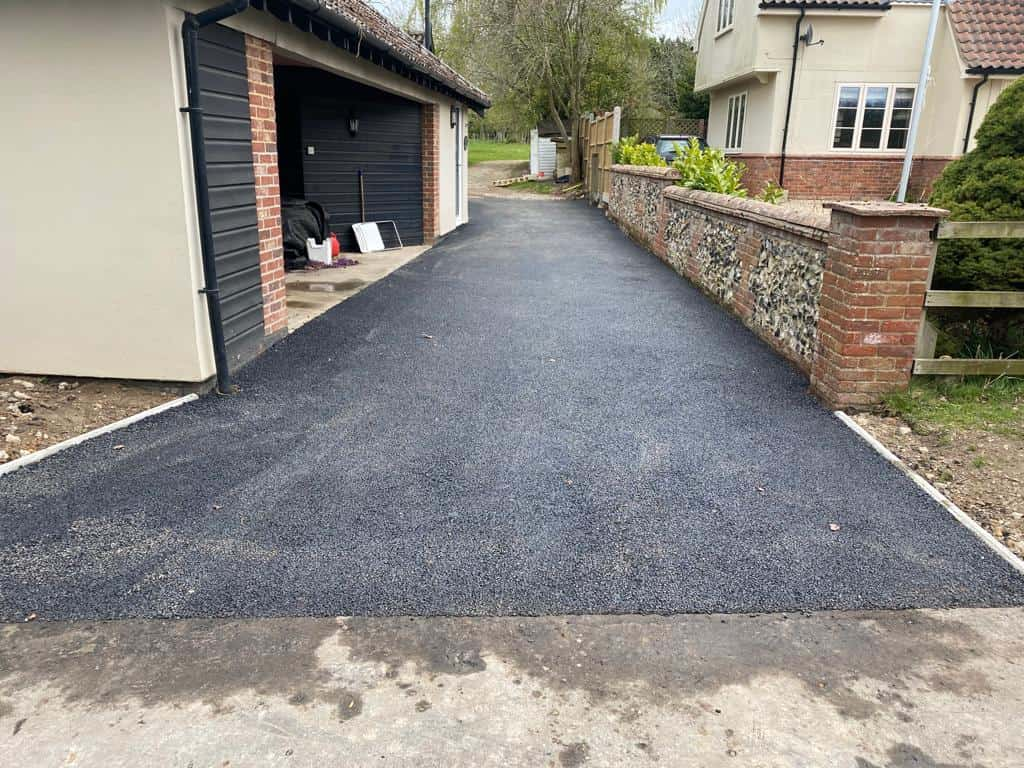
Should You Repair, Resurface or Replace Your Existing Driveway?
An ageing driveway does not automatically need to be completely replaced. Cracks, worn areas, surface deterioration and minor movement can sometimes be addressed through targeted repairs or resurfacing, while more substantial problems may indicate that the driveway needs rebuilding from the foundations upwards.
For property owners in Sudbury, Suffolk, deciding whether to repair, resurface or replace a driveway should begin with understanding why it has deteriorated. The visible surface is only part of the construction, and the condition of the base beneath it can be just as important when determining the most appropriate solution.
Start by Understanding Why the Driveway Is Deteriorating
Before deciding what work is needed, it is important to identify the cause of the problem.
Driveways can deteriorate because of:
- Long-term vehicle use
- Weather exposure
- Ground movement
- Poor drainage
- An inadequate sub-base
- Localised settlement
- Ageing surface materials
- Previous repairs reaching the end of their useful condition
Some of these problems affect only the surface. Others originate deeper within the driveway construction.
This distinction is what often determines whether repair, resurfacing or replacement is appropriate.
When Is a Driveway Repair Usually Enough?
Repair is generally most suitable when deterioration is confined to relatively small areas and the surrounding driveway remains stable.
Examples might include isolated cracks, small damaged sections, minor edge deterioration or individual areas that have been affected without compromising the wider surface.
A targeted repair can restore the affected section while retaining the serviceable parts of the existing driveway.
The important consideration is whether the defect is genuinely localised. If similar problems are appearing throughout the driveway, repairing each one individually may not address the underlying cause.
Localised Damage Does Not Always Mean Wider Failure
It is easy to assume that visible damage means the entire driveway is deteriorating, but this is not always the case.
A small area may have been affected by a particular weakness while the majority of the driveway remains in good condition.
Professional assessment can determine whether the surrounding construction is stable and whether the affected area can be repaired effectively.
Where this is possible, there may be no reason to disturb sound sections unnecessarily.
When Does Resurfacing Make Sense?
Resurfacing can be considered when the existing driveway has become generally worn but still has a suitable underlying foundation.
Rather than rebuilding the entire driveway, the existing construction can potentially provide support for a renewed surface, subject to its condition and compatibility with the proposed material.
This approach can be particularly relevant where the driveway has:
- Widespread surface wear
- Fading or weathering
- Numerous minor surface defects
- An uneven visual appearance
- Previous repair areas
- A generally tired finish
The key requirement is that the problems are primarily associated with the upper surface rather than significant instability underneath.
Resurfacing Cannot Correct a Failed Foundation
A new surface can improve appearance and restore performance, but it cannot compensate for a fundamentally unstable base.
If the driveway is sinking, moving or breaking up because the underlying construction is inadequate, placing another surface above it may simply conceal the problem temporarily.
Movement beneath the driveway can eventually transfer through to the new finish.
Before resurfacing, it is therefore essential to establish whether the existing base is capable of providing suitable long-term support.
What Does Widespread Cracking Tell You?
Cracking can occur for different reasons, so its pattern matters.
One isolated crack may have a local cause. Numerous cracks appearing throughout the driveway can suggest more general movement or deterioration.
A professional assessment should consider:
- Where the cracks are located
- Whether they are increasing
- Whether surrounding areas are moving
- Whether water is entering damaged sections
- Whether previous repairs have cracked again
Repeated cracking in repaired areas can be particularly useful evidence that the problem may originate below the visible surface.
Sinking and Settlement Need Closer Investigation
Low spots and sunken sections often indicate that something beneath the surface has changed.
The underlying materials may have moved, compacted unevenly or lost suitable support. Water-related issues can also contribute to deterioration in some circumstances.
Simply filling a depression without addressing why it developed may not provide a dependable result.
Where settlement is extensive, sections of the driveway may need to be excavated and reconstructed so that suitable support can be restored.
Drainage Should Be Considered Before Any Major Work
Water management plays an important role in driveway performance.
If water regularly collects on the surface, the issue may involve levels, drainage or localised settlement. Simply renewing the surface without addressing these factors could allow the same problem to continue.
Before resurfacing or replacement, it is sensible to consider:
- Where rainfall currently travels
- Whether standing water develops
- Whether sections drain effectively
- How the driveway connects with surrounding areas
- Whether existing levels are appropriate
A well-planned driveway should manage water as part of its overall construction.
When Is Full Driveway Replacement More Appropriate?
Replacement becomes more relevant when deterioration extends beyond the surface and affects the structural integrity of the driveway.
This may be the case where there is:
- Widespread settlement
- Significant movement
- Extensive surface failure
- Repeated cracking after previous repairs
- An unsuitable or deteriorated sub-base
- Multiple interconnected problem areas
- Significant changes required to levels or layout
Removing the existing construction allows the underlying ground to be assessed and a suitable foundation to be established before the new surface is installed.
The Sub-Base Is Critical to the Decision
The quality of the finished driveway depends heavily on what lies underneath it.
A suitable sub-base helps distribute vehicle loads and provides stable support for the surface. If this structural layer is inadequate, even a high-quality finish may eventually experience movement.
When considering replacement, rebuilding the underlying construction provides an opportunity to correct weaknesses that cannot be solved through surface-level work alone.
This is why the condition of the foundation should play a major role in deciding between resurfacing and replacement.
Previous Repairs Can Provide Useful Clues
A driveway containing several historic repairs is not necessarily in poor condition. Proper repairs can successfully extend the useful life of an existing surface.
However, the pattern of those repairs is worth considering.
If new defects repeatedly appear in different areas, or repaired sections continue failing, the driveway may be experiencing wider deterioration.
At that point, continuing to treat individual symptoms may become less effective than considering the condition of the driveway as a whole.
Think About How the Driveway Is Used Today
An older driveway may have been designed for very different requirements from those of the household today.
Changes in vehicle numbers or the way parking space is used can influence whether simply repairing the existing layout makes sense.
More extensive driveway work can provide an opportunity to consider:
- Parking arrangements
- Vehicle access
- Pedestrian movement
- Edging
- Drainage
- The overall shape of the usable area
The objective should be to create a surface that works effectively for the property rather than simply reproducing an existing layout that no longer meets its needs.
Appearance Is Only One Part of the Decision
A faded or tired driveway can often look considerably better after appropriate resurfacing. However, appearance should never be the only consideration.
A driveway can look worn while remaining structurally sound. Equally, a relatively tidy surface may conceal movement or inadequate support underneath.
The correct solution should therefore address performance first and appearance alongside it.
Why Professional Assessment Matters
Choosing between repair, resurfacing and replacement requires more than looking at the most obvious defect.
At Sudbury Driveway Solutions, we provide professional driveway surfacing services throughout Sudbury, Suffolk. Existing driveways can be assessed to establish the extent of deterioration and determine whether problems are confined to the surface or connected to the construction beneath it.
Where a targeted repair can resolve the problem, unnecessary wider work may not be required. Where the existing base remains suitable, resurfacing may provide an effective way to renew the driveway. Where deterioration is structural or widespread, replacement can address the driveway more comprehensively.
The objective is to recommend work based on what the existing driveway genuinely requires.
Repair, Resurface or Replace: What Matters Most?
There is no single solution that is right for every ageing driveway.
The decision should take account of:
- The extent of visible damage
- The stability of the existing surface
- The condition of the sub-base
- Drainage and surface levels
- The frequency of previous repairs
- The intended use of the driveway
- Whether deterioration is localised or widespread
Looking at these factors together provides a much clearer basis for choosing the appropriate approach.
Conclusion
Whether an existing driveway should be repaired, resurfaced or replaced depends primarily on the cause and extent of its deterioration.
Localised defects on an otherwise stable driveway may only require targeted repair. A generally worn surface supported by a suitable underlying construction may be a candidate for resurfacing. Where there is widespread settlement, structural movement or an inadequate foundation, replacement may provide the more appropriate long-term solution.
For property owners in Sudbury, Suffolk, Sudbury Driveway Solutions can assess existing driveway surfaces and recommend an approach based on their actual condition. If your driveway is cracking, sinking, becoming uneven or simply showing widespread signs of age, a professional assessment can help determine whether repair, resurfacing or replacement is the most suitable way forward.
Call us on: 01787 322 199
Click here to find out more about Sudbury Driveway Solutions
Click here to complete our contact form and see how we can help with your driveway needs.